In football, although the best route to goal is through the middle of the field, the quickest way forward is often through the wings. As the central areas are therefore the most vulnerable for the defence, the defence is often centralised to protect this area, leaving the wings exposed and open. Therefore, wing play is a crucial aspect to football.
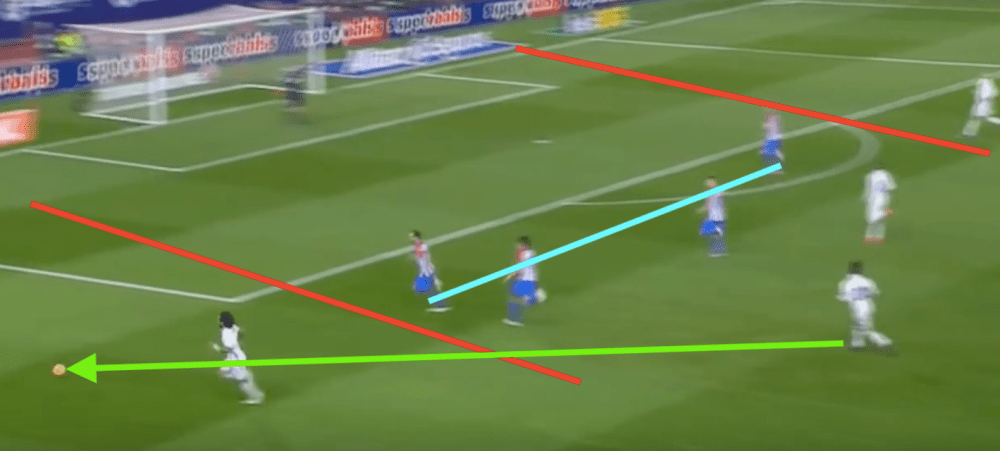
For example, in the picture (below), Atletico Madrid’s central defenders are about as wide as half the box (blue line). Although this may be efficient in dealing with central attacks, as soon as the ball is passed to the wing areas (green arrow), there is ample space (outside of the red lines) for the attacker to think about their next move, be it cut inside, chip to the far post, or whip in a low cross. Therefore, the art of wing attack is an all-important tactic to learn.
There are two main aspects to wing play: overload and choice.
Overload
The best attackers in the game overload the opposition to get to the wings. To do this, the full-back often is bombed forward. For example, in the photo above, the ‘winger’ is Marcelo, Real Madrid’s left back. This firstly allows the strikers and attacking midfielders to dedicate themselves to purely getting into dangerous positions in the area. Secondly, it allows two on one situations with the full backs on the other team, so that the opposing defender cannot press the wing, as they would leave exposed areas behind them.
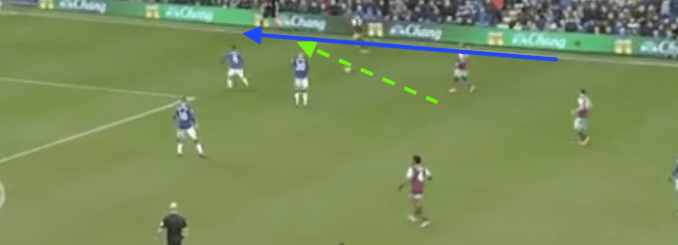
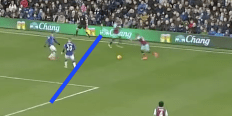
For example, in the picture below (left), West Ham are attacking Everton. Payet slides the ball to Antonio (green), who is on the overlap (blue) to isolate Oviedo, the full back. Antonio not only draws in Oviedo, but also Barkley, so that when he chooses to pass the ball back to Payet, Payet can easily cross, and eventually cause a goal.
Choice
When the ball comes to the winger, they then must choose what to do. After finding themselves in space, due to the overload, they have to decide what the most dangerous pass would be.
There are usually three or four options here.
Firstly, he could cross it into the box. Usually, the cross would be directed to the far or near post, and not central, to minimise the chance of the goalkeeper catching the ball. It should ideally be in front of the striker as well so that they can gain momentum by running onto the ball to head it powerfully. Secondly, he could cut inside. This is becoming a more frequently used tactic in modern football as it has a better success rate if it works. Thirdly, they could pass it back to the midfielder outside the box, or the person who gave the player the ball. This is possibly the safest of the three options, but it doesn’t offer much threat.
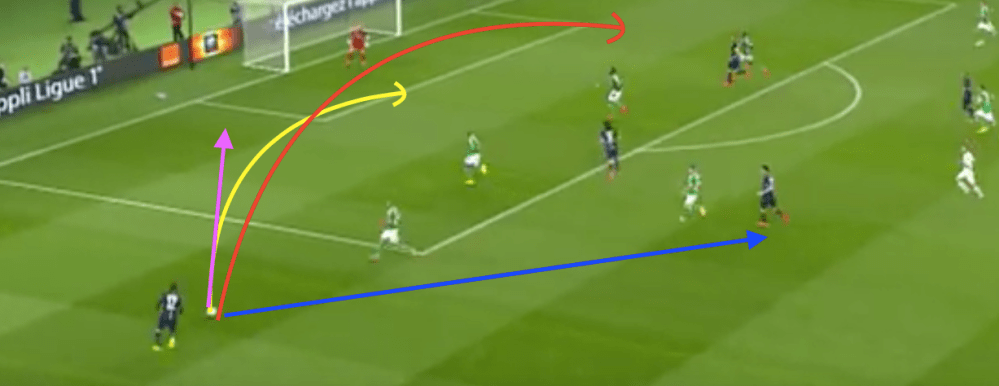
For example, in this PSG attack below, the winger has these options. He could pass back to the midfielder (blue) although this would be a poor choice as the midfielder is closely marked by the defender and has little goal threat from outside the box. He could also cut inside (pink) and head to the goal. This may have worked as there is plenty of space available. However, there could be potentially two defenders pressing him, so this would also be a poor option. He finally has two crosses he could do (yellow and red). The yellow cross would be the worse out of the tow as there are two defenders on the one attacker and the goal keeper is in a good position to stop the shot or header. Therefore, he chooses the red cross and the ball is headed into the back of the net.
 THE SPORT BLOG